Salesforce architect certification path
The architect path is long and the order matters. This guide lays out the designer exams and how they lead to Application Architect, System Architect and CTA.
On this page (7 sections)
What is the Salesforce architect pyramid?How the pyramid worksA realistic order and timelineWhat each designer exam is really aboutThe CTA review boardTips from people who have done itInterview questionsThe architect path is the longest journey in the Salesforce certification programme, and the most respected. It is built as a pyramid: a set of designer and developer exams at the bottom, two architect credentials in the middle, and the Certified Technical Architect (CTA) review board at the top. This guide explains how the pieces fit, which exams to take in which order, and what the CTA board actually involves.
What is the Salesforce architect pyramid?
The Salesforce architect pyramid is the certification path for Salesforce architects. At the base are two foundation exams (Platform App Builder and Platform Developer). Above them are five designer exams. Passing the right exams earns two credentials automatically, Application Architect and System Architect, and holding both lets you attempt the top level: the Certified Technical Architect (CTA) review board.
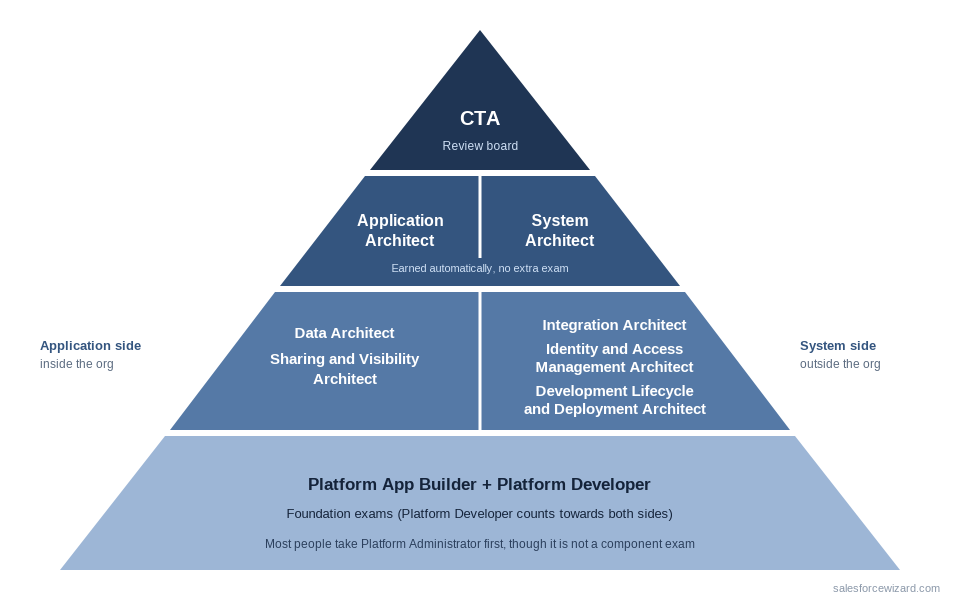
| Level | What you need | Exams |
|---|---|---|
| Foundation | Platform App Builder, Platform Developer | 2 |
| Designer exams | Data, Sharing and Visibility, Integration, Identity and Access Management, Development Lifecycle and Deployment | 5 |
| Application Architect + System Architect | Awarded automatically when the component exams are passed | 0 |
| Certified Technical Architect (CTA) | Both architect credentials, then the review board | Review board |
In total that is 7 multiple-choice exams plus the CTA review board. Exam fees are USD 200 for the foundation exams and USD 400 for each designer exam; the review board costs USD 4,500 (see all Salesforce certifications and fees).
How the pyramid works
There are two domain credentials. You do not take an exam for them; you earn each one automatically once you pass all of its component exams.
| Credential | Component exams | Focus |
|---|---|---|
| Application Architect | Platform App Builder, Platform Developer, Data Architect, Sharing and Visibility Architect | Designing what lives inside the org: data model, security, declarative and programmatic build |
| System Architect | Platform Developer, Development Lifecycle and Deployment Architect, Identity and Access Management Architect, Integration Architect | How the org works with the outside world: integration, identity, release management |
| Certified Technical Architect (CTA) | Both credentials above, then the CTA review board | End-to-end solution design for complex enterprise scenarios |
Salesforce renamed several exams in 2025 and 2026 and is retiring others, such as B2B Solution Architect, on 1 February 2027, but the Application Architect, System Architect and CTA structure is unchanged. Check the official architect page on Trailhead Academy for the current component list before you plan.
A realistic order and timeline
- Foundation (months 1–6): Platform App Builder and Platform Developer. Most people take Platform Administrator before these, even though it is not a component exam.
- Application Architect (months 6–15): Sharing and Visibility Architect first, because it builds on admin knowledge you already have, then Data Architect.
- System Architect (months 15–27): Development Lifecycle and Deployment Architect is usually the most approachable; Integration Architect and Identity and Access Management Architect need the most real-world exposure.
- CTA preparation (one to two years more): practice scenarios, mock boards and a study group or mentor.
These timelines assume study alongside a full-time job and real project exposure. People who rush exams without project experience often pass the multiple-choice tests but struggle badly at the board.
What each designer exam is really about
- Sharing and Visibility Architect: designing the security model for large, complex orgs, including implicit sharing, Apex managed sharing and performance at scale.
- Data Architect: data modelling, large data volumes, skew, archiving and data quality strategy.
- Integration Architect: choosing integration patterns, APIs, events and middleware, and handling errors and limits.
- Identity and Access Management Architect: single sign-on, SAML, OAuth flows, social sign-on and customer identity.
- Development Lifecycle and Deployment Architect: environments, source control, release strategy, testing and governance.
The CTA review board
The board is a live exam. You receive a detailed, fictional business scenario, prepare a solution in a fixed time, present it to a panel of judges, then defend it under questioning. You must cover data, security, integration, identity, development lifecycle and the trade-offs behind every choice.
Candidates usually spend a year or more preparing, often with a mentor and regular mock boards. Many do not pass on the first attempt, and that is normal; feedback from a failed attempt is a large part of how people eventually pass.
Tips from people who have done it
- Draw everything: system landscape, data model, role hierarchy and integration diagrams. Architects communicate in diagrams.
- Always state the trade-off. "I chose X because Y, accepting Z" is the sentence judges want to hear.
- Get real project exposure in your weak domain, especially identity and integration, before attempting those exams.
- Join an architect study group: explaining your design to others is the best preparation for the board.
For interviews on the way there, use the architect interview questions and integration scenarios.
01Do I need to take an exam for Application Architect or System Architect?
Do I need to take an exam for Application Architect or System Architect?
No. Each credential is granted automatically once you hold all of its component certifications.
02How long does the full path to CTA take?
How long does the full path to CTA take?
Typically three to five years for the component exams and credentials alongside project work, plus one to two years of focused board preparation.
03Which designer exam should I take first?
Which designer exam should I take first?
Sharing and Visibility Architect is a common first choice because it builds on admin and developer security knowledge you already use daily.
04Are architect certifications worth it without becoming a CTA?
Are architect certifications worth it without becoming a CTA?
Yes. The Application and System Architect credentials are strongly valued for solution and technical architect roles even if you never sit the board.
05How many exams are in the Salesforce architect pyramid?
How many exams are in the Salesforce architect pyramid?
Seven multiple-choice exams: Platform App Builder, Platform Developer, and five designer exams (Data, Sharing and Visibility, Integration, Identity and Access Management, Development Lifecycle and Deployment). After that, the CTA review board is a separate scenario-based presentation, not a multiple-choice exam.
06Is Platform Administrator part of the architect pyramid?
Is Platform Administrator part of the architect pyramid?
No. It is not a component exam for Application or System Architect, but most people take it first because the designer exams assume strong admin knowledge.
07How much does it cost to become a Salesforce CTA?
How much does it cost to become a Salesforce CTA?
At current list prices: two foundation exams at USD 200, five designer exams at USD 400 and the review board at USD 4,500, about USD 6,900 before taxes and retakes. Many people's employers pay, because partners value architect credentials.